
The Scottish Music Industry Association (SMIA), supported by an independent Equality, Diversity, Inclusion and Accessibility (EDIA) Advisory Group, has developed the Scottish Music EDIA Manifesto alongside a practical EDIA Action Framework.
The development of this work included consultation with people working across different areas of Scotland’s music industry.
The Manifesto and Action Framework respond to barriers relating to class, race and ethnicity, disability, gender, sex, sexuality, neurodiversity, geography and more that continue to shape who can participate fully in Scottish music.
These barriers are well-documented and widely experienced. This work is a collective commitment to addressing them.
What are these documents?
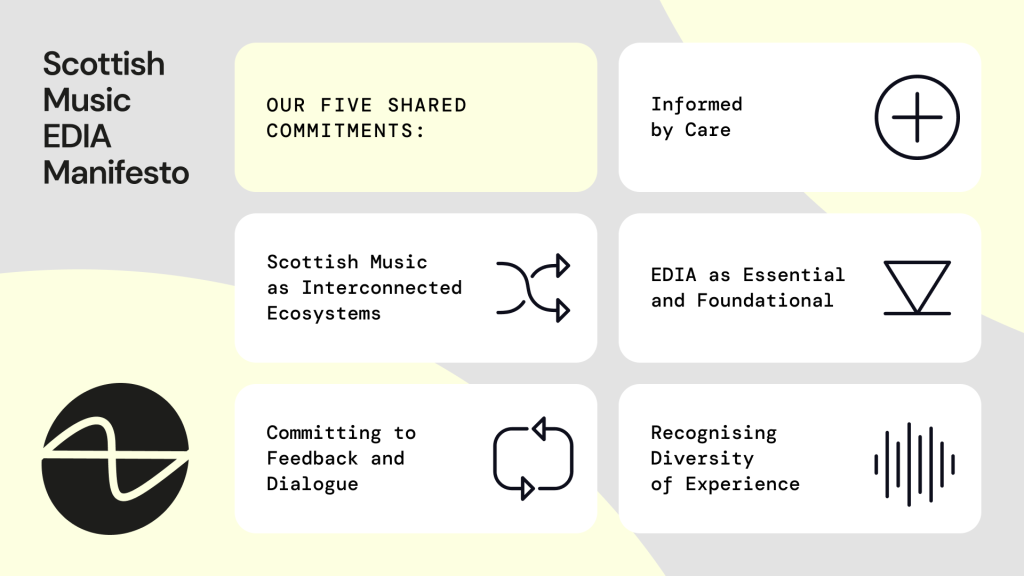
The Manifesto sets out five shared commitments, alongside the values and principles that underpin this work. Here they are at a glance:
The Action Framework provides practical guidance, examples and tools to support meaningful, proportionate action over time. It is built around three areas of focus:
- Investment – considering how resources, opportunities and decision-making can support greater equity and inclusion.
- Training – developing knowledge, skills and understanding through ongoing learning.
- Feedback – creating opportunities for dialogue, reflection and continuous improvement.
Both documents are designed to be flexible and achievable, recognising the wide range of roles, resources and contexts that make up Scotland’s music industry.
This is a voluntary commitment, focused on reflection, learning and steady improvement rather than compliance or enforcement.
Read the Scottish Music EDIA Manifesto + Action Framework:
What Signing Means:
Signing the Scottish Music EDIA Manifesto is a commitment to engage with equity, diversity, inclusion and accessibility as an ongoing process.
It means recognising that creating a more equitable, inclusive and accessible music sector requires continual reflection, learning and action over time.
What Will I Need To Do?
Signatories commit to:
- Reflecting on their working practices and decision-making
- Reviewing their approach to EDIA at least once per year
- Taking at least one meaningful, realistic and proportionate action annually
- Creating space for feedback, dialogue and learning
- Considering how barriers can be reduced within their own area of work or influence
The accompanying Action Framework has been developed to support this process.
You can also access the Action Framework in Practice resource, which provides examples of how the Framework can be applied in different contexts.
Additional resources and learning materials are available to support ongoing reflection, learning and action.
Actions will look different depending on who you are and how you work.
A freelance artist, volunteer-run collective, grassroots music venue and national organisation are not expected to take the same approach.
What matters is engaging with the process in a way that is meaningful and proportionate to your circumstances.
What Signing Does Not Mean:
Signing the Manifesto does not involve:
- Demonstrating perfection or having all the answers
- Legal obligations or compliance reporting
- Fixed targets or one-size-fits-all expectations
- Immediate or large-scale organisational change
This commitment is about meaningful progress over time, not perfection.
Above all, signing means becoming part of a sector-wide effort to help make Scottish music a place where everyone, regardless of background, identity or geography, can participate fully, fairly and safely.
How to Sign:
There are two ways to sign the Scottish Music EDIA Manifesto, depending on how you work within the sector. Please choose the option that best reflects your role.
Questions before signing? Contact the SMIA team at info@smia.org.uk
For organisations, collectives, bands, venues, festivals, promoters, labels, agencies, companies and other music-related bodies.
This means:
- Your organisation will be listed as a public signatory
- Your commitment applies to your organisation, band, project or business as a whole
- You are signing on behalf of your organisation (with permission)
For freelance music creators, practitioners, sole traders and individuals working across Scotland’s music sector.
This means:
- You are signing as an individual
- Your commitment reflects your own practice, roles and influence
- You will be listed as a public signatory
What Happens Next:
Once you sign, you will:
- Receive a digital signatory badge
- Be included in the public signatory list
- Gain access to ongoing resources and guidance
- Receive updates about relevant events, learning opportunities and project developments
We will continue to keep signatories informed as the work develops and support engagement at a pace that is appropriate to different contexts and capacities.
SMIA EDIA Self-Mobilisation Micro-Grants
To support signatories in putting their commitments into practice, the SMIA offers EDIA Self-Mobilisation Micro-Grants of up to £1,000.
Available exclusively to signatories of the Scottish Music EDIA Manifesto and Action Framework, the fund supports practical activities that advance equity, diversity, inclusion and accessibility across Scotland’s music industry.
Deadline: 5pm Thursday 23 July 2026
Find out more about the SMIA EDIA Self-Mobilisation Micro-Grants, eligibility and how to apply →
Current Signatories:
We’re proud to be joined by a growing network of organisations and individuals committed to supporting equity, diversity, inclusion and accessibility across Scotland’s music industry.
74 Organisations | 59 Individual Signatories
View all Current Signatories →
Feedback & Dialogue:
We recognise that building a more equitable, diverse, inclusive and accessible music industry is ongoing work.
The Scottish Music EDIA Manifesto and Action Framework are intended to support continued reflection, learning and action, and we welcome feedback and dialogue as this work develops.
If you’d like to share your thoughts, ask questions or discuss the project further, please contact us at info@smia.org.uk and the team will pick up with you.
Frequently Asked Questions:
About the Scottish Music EDIA Manifesto:
What is the Scottish Music EDIA Manifesto?
Supported by Creative Scotland, the Scottish Music EDIA Manifesto and Action Framework were developed over a two-year period through the SMIA’s independent EDIA Advisory Group and consultation with stakeholders from across Scotland’s music ecosystem. While the Manifesto sets out five core pledges for the future development of the industry, the accompanying Action Framework translates those principles into practical delivery through a series of commitments focused on investment, training and feedback
Accordion content.
Why was this Manifesto created?
Scotland’s music industry is home to extraordinary talent, but participation continues to be shaped by barriers that have nothing to do with skill. The Manifesto and accompanying Action Framework provide a clear, collective framework for understanding these barriers and taking practical, proportionate steps to address them over time.
Accordion content.
Who developed it?
An EDIA Advisory Group appointed by the SMIA in 2024 through an open call, supported by sector-wide consultation across Scotland’s music industry.
Accordion content.
What is the Scottish Music Industry Association (SMIA) committing to itself?
The same standards the SMIA is inviting others to uphold apply equally to us. This includes being honest about where change is needed, strengthening our own policies and approaches, and committing to the same ongoing, iterative process this work asks of the sector.
Accordion content.
How will the Manifesto and Action Framework be updated over time?
Both documents are intended to evolve as the sector does. The SMIA will review and update them over time, informed by signatory feedback, sector developments and ongoing learning. This is not a fixed endpoint, it is part of an ongoing and iterative process.
Accordion content.
About Signing:
Who can sign the Manifesto?
Both individuals and organisations working within Scotland’s music sector are invited to sign.
Accordion content.
Is signing different for individuals and organisations?
The core commitments are the same. The difference is how the commitment is applied.
Accordion content.
Why are artists being asked to sign?
Artists play an important role in shaping the culture, practices and future of Scotland’s music industry. The Scottish Music EDIA Manifesto is intended for the whole music ecosystem, including artists, bands, freelancers, organisations, venues, festivals and industry professionals. By involving artists alongside organisations and music businesses, the Manifesto aims to reflect the realities of how music is created, performed and experienced across Scotland, while building a visible, collective commitment to making the sector more equitable, accessible and inclusive over time.
Can my band sign the Manifesto?
Yes. Bands, artist projects and music groups can sign as an organisation if they wish to make a collective commitment as a group. Alternatively, individual members can sign separately as individuals. You should choose the option that best reflects how you would like the commitment to be recognised.
Accordion content.
Can I sign as an individual rather than an organisation?
Yes. Individuals working in the Scottish music sector are warmly invited to sign. The Manifesto is for everyone, regardless of whether you work independently or as part of an organisation.
Accordion content.
Can organisations and individuals outside Scotland sign?
The Scottish Music EDIA Manifesto and Action Framework are designed for those working within Scotland’s music industry. If your work is based in or significantly connected to Scotland’s music industry, you are welcome to sign.
Accordion content.
What information do we need to provide when signing?
The signing forms ask for basic details about you (as an individual signatory) or your organisation. Both forms take five minutes or less to complete.
Accordion content.
How long does signing take?
Five minutes or less.
Accordion content.
Does signing mean we need to overhaul everything at once?
No. Signing is not an expectation of rapid or large-scale change. It is a commitment to steady, proportionate progress and annual review. Not perfection right away.
Accordion content.
What if I am already doing EDIA work? Do I need to start from scratch?
No. Many signatories are already doing this work. Signing is an opportunity to build on what you have, make that work visible and commit to continuing it. This is iterative, and that means you do not need to start from scratch.
Accordion content.
Is this a legal or compliance document?
No. It is a voluntary, sector-led commitment, not a legal contract. It sets shared expectations, not binding obligations.
Accordion content.
Who should we contact if we have questions before signing?
If you have questions about the Manifesto, the Action Framework, or the signing process, you can contact info@smia.org.uk.
Accordion content.
Can we provide feedback before signing?
If you have questions, concerns or comments before making a decision, please get in touch via info@smia.org.uk.
Accordion content.
Process and Expectations:
Is this relevant to small organisations, grassroots music venues or freelancers?
Yes, and the commitment is designed to be proportionate. A volunteer-run collective and a major institution are not expected to do the same things. What matters is that your actions are meaningful for your capacity and context. The Action Framework and our supporting resources include some practical examples, but we trust signatories to find approaches that work for them.
Accordion content.
What does the annual review involve?
A light-touch annual reflection with three elements; reviewing progress, identifying one new area for improvement and taking at least one proportionate action. These actions are supported by the guidance in the EDIA Action Framework.
Accordion content.
Do we need to report back to the SMIA?
There is a light-touch annual reflection process, flexible and proportionate to your capacity. We want to hear about your work, wins and challenges in whatever way suits you best.
Accordion content.
What support will the SMIA provide after signing?
Signatories will receive; a digital badge for use on your website and communications, invitations to sector conversations, workshops, engagement sessions, and other learning opportunities alongside access to EDIA micro-grants.
Accordion content.
What happens if our circumstances change and we cannot complete our annual action?
Please let us know during your reflection, or at any other touchpoint. We want to hear about challenges as much as wins. That honesty is part of what makes this work effective in the long run, and is important for us to document.
Accordion content.
How do we update our details after signing, for example if our logo or contact information changes?
Reach out to us at info@smia.org.uk and we will be happy to help!
Accordion content.
Can signatories withdraw later?
Yes. Individuals or organisations can request removal from public signatory listings if circumstances change.
Accordion content.
Taking Part:
Do we need to publish anything publicly once we sign?
No. However, signatories will receive a digital badge they are welcome to use, and will be listed on the SMIA website (unless they would prefer not to be).
Accordion content.
Are the regular EDIA Engagement Sessions exclusive to signatories?
Yes. More details will be announced soon.
Accordion content.
Where can I find definitions of the terms used in the Manifesto and Action Framework?
The EDIA Glossary covers key terms used across both documents. It’s linked in our Resources Page.
Accordion content.
How will the SMIA use the information we provide when signing?
When you sign the Manifesto and Action Framework, the SMIA will gather only the relevant data needed. All information will be collected and stored in accordance with our Data Use And Privacy Policy. Your email address, name and role will be used for direct communications from the SMIA team regarding updates, guidance, resources and information to support this work. Your email address will also be used for our annual light touch evaluation process on this work. Your name, logo, and optional quote will be profiled on the website, and in related communications and PR announcements.
If you have any questions or concerns regarding the personal data we collect from you and the terms set out in this policy, please email info@smia.org.uk and we will get back to you as soon as possible.
Accordion content.
About the EDIA Advisory Group:
An EDIA Advisory Group was appointed by the SMIA in 2024 following an open application process. Over eight bi-monthly meetings, and through sector-wide consultation conducted in line with Fair Work principles, the group developed the Scottish Music EDIA Manifesto and accompanying Action Framework.
Feedback from that consultation directly shaped the final documents, including strengthening the focus on proportionality and making clear that this work is intended to build on existing EDIA activity across the sector rather than duplicate it.